
What to Expect from a Tailwheel Endorsement
Most pilots learn to fly in an airplane that wants to track straight on its own. A taildragger doesn't — and that's exactly why a tailwheel endorsement makes you a sharper pilot, not just a differently-rated one.
If you learned to fly in a tricycle gear airplane — and most pilots did — a tailwheel endorsement is the first time your feet do more work than your hands. It's not a harder version of flying, it's just a different conversation with the airplane, and it's one every pilot should have at least once.
Here's what the training actually involves, how long it takes, and why it's worth doing even if you never plan to own a taildragger.
What the FAA Actually Requires
A tailwheel endorsement isn't a certificate or rating — it's a logbook endorsement from an instructor, added under FAR 61.31(i). To earn it, you need to demonstrate:
Normal and crosswind takeoffs and landings
Wheel landings
Go-around procedures
That's the regulatory minimum. The real training is everything underneath those bullet points — the actual skill that makes them possible.
Why Tailwheel Flying Is a Different Skill
In a tricycle gear airplane, the airplane wants to track straight on its own. In a taildragger, it doesn't — the center of gravity sits behind the main wheels, which means any uncorrected yaw on landing wants to turn into a swerve, and an uncorrected swerve wants to turn into a ground loop. Your feet, not your hands, are what keep that from happening.
This is why tailwheel training builds skills that carry over into every other kind of flying:
Rudder coordination that becomes automatic instead of an afterthought
Directional control in a way tricycle gear training rarely demands
Energy management on landing, since a taildragger gives you less room for error on sloppy control inputs
Pilots who train tailwheel often say their tricycle gear landings get noticeably better afterward — not because they're flying a different airplane, but because their feet finally caught up to their hands.
What the Training Actually Looks Like
A typical tailwheel course builds progressively:
Three-point landings — the classic taildragger landing, all three wheels touching at once
Wheel landings — touching down on the mains first, holding the tail off, a technique that matters more in gusty or crosswind conditions
Crosswind work, starting light and building toward more challenging conditions
Bounce and swerve recovery — practiced deliberately, so the correct reaction is automatic instead of a panic response the first time it happens for real
There's no FAA-mandated minimum number of hours. Most pilots complete a solid endorsement in roughly 7 to 8 hours, though the honest answer is: it takes as long as it takes to be consistently safe across a range of conditions, not just on a calm-wind day.
Training in Colorado Changes the Equation
Tailwheel flying in Colorado Springs comes with a variable most pilots training at sea level never have to think about: density altitude. Add a gusty crosswind — common here — and a taildragger's demands on your feet get sharper, not gentler. Training in genuinely challenging conditions, rather than ideal ones, is part of why pilots who train here tend to leave with greater margins in their skill set, not less.
Training with WETSU Aviation
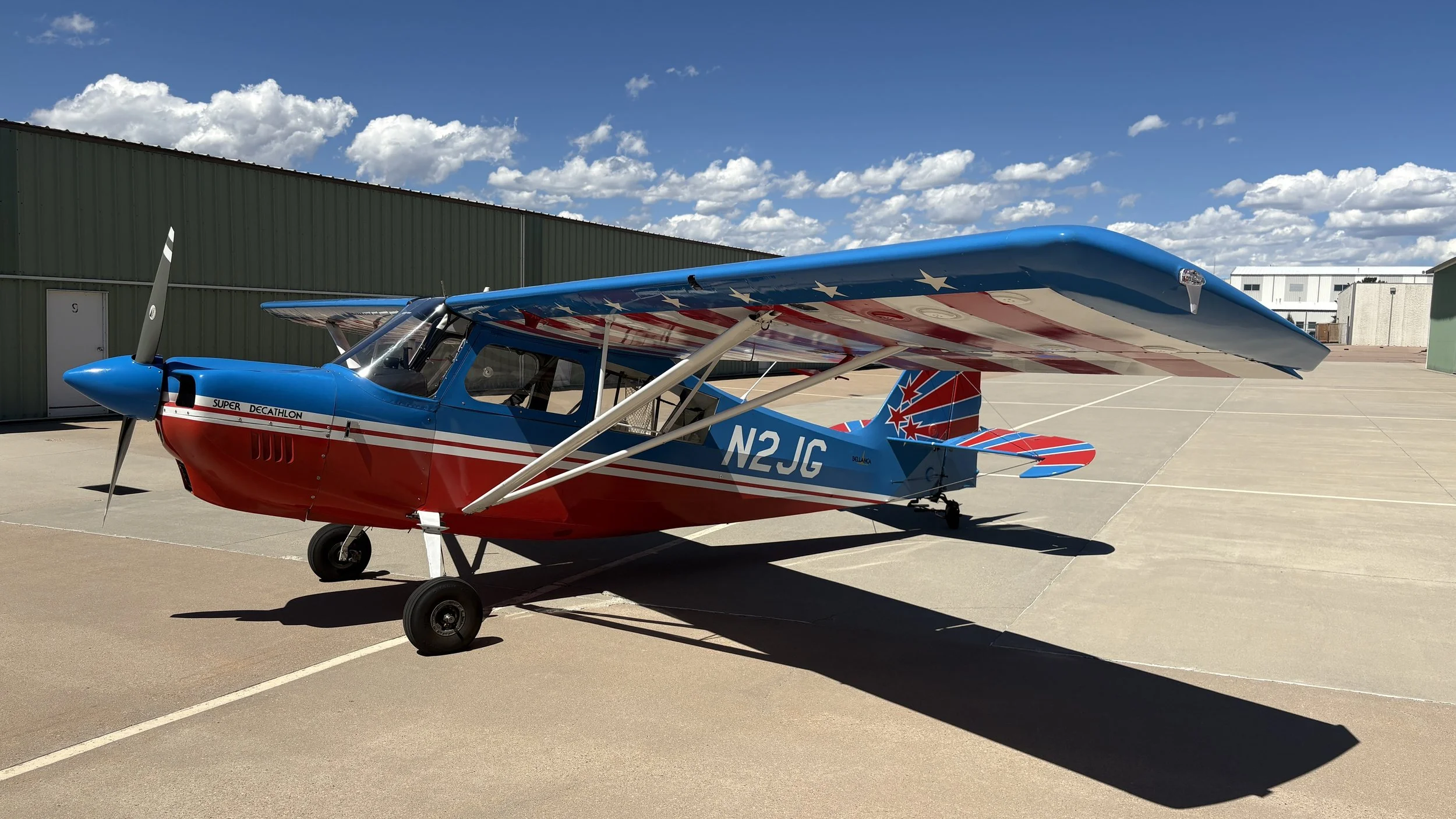
At WETSU, tailwheel endorsement training happens in our Super Decathlon, N2JG — an airplane built for exactly this kind of flying. There's no hourly minimum and no certificate requirement beyond holding a single-engine certificate, private or commercial. You don't need prior aerobatic or backcountry experience to start; tailwheel is often where pilots begin before moving into our aerobatic, upset, or backcountry programs.
Ready to start? Apply here and let us know which program you're after — we'll get you on the schedule.